The Archer
doesn't have a GPU.
We're shipping the one it needs.
A 67-TOPS on-board AI payload for the Neros Archer-class FPV platform — custom 74×46 mm carrier, NVIDIA Jetson Orin Nano Super 8GB, NDAA-sourced. Slots in as a secondary deck above the existing FC. $320 in components. 120 grams. Eight weeks to first flight.
01 · Market gap
Nobody has shipped a 5–8" race-class drone with real on-board autonomy.
Neros Technologies — DoD Replicator favorite, Blue UAS cleared, 2,000+ units/day — ships a custom FC with "robust autonomy" on the roadmap. The fielded baseline is operator-piloted FPV. No public TOPS number. No AI co-processor. The recent Archer Fiber variant is a tether — a jamming-resistance play, not an autonomy play.
That's the gap. An autonomy-equipped Archer-class strike platform that doesn't exist yet — and is straightforward to build on commodity NDAA-sourceable parts.
02 · The build
A clean-sheet carrier, sized to the SOM. Nothing extra.
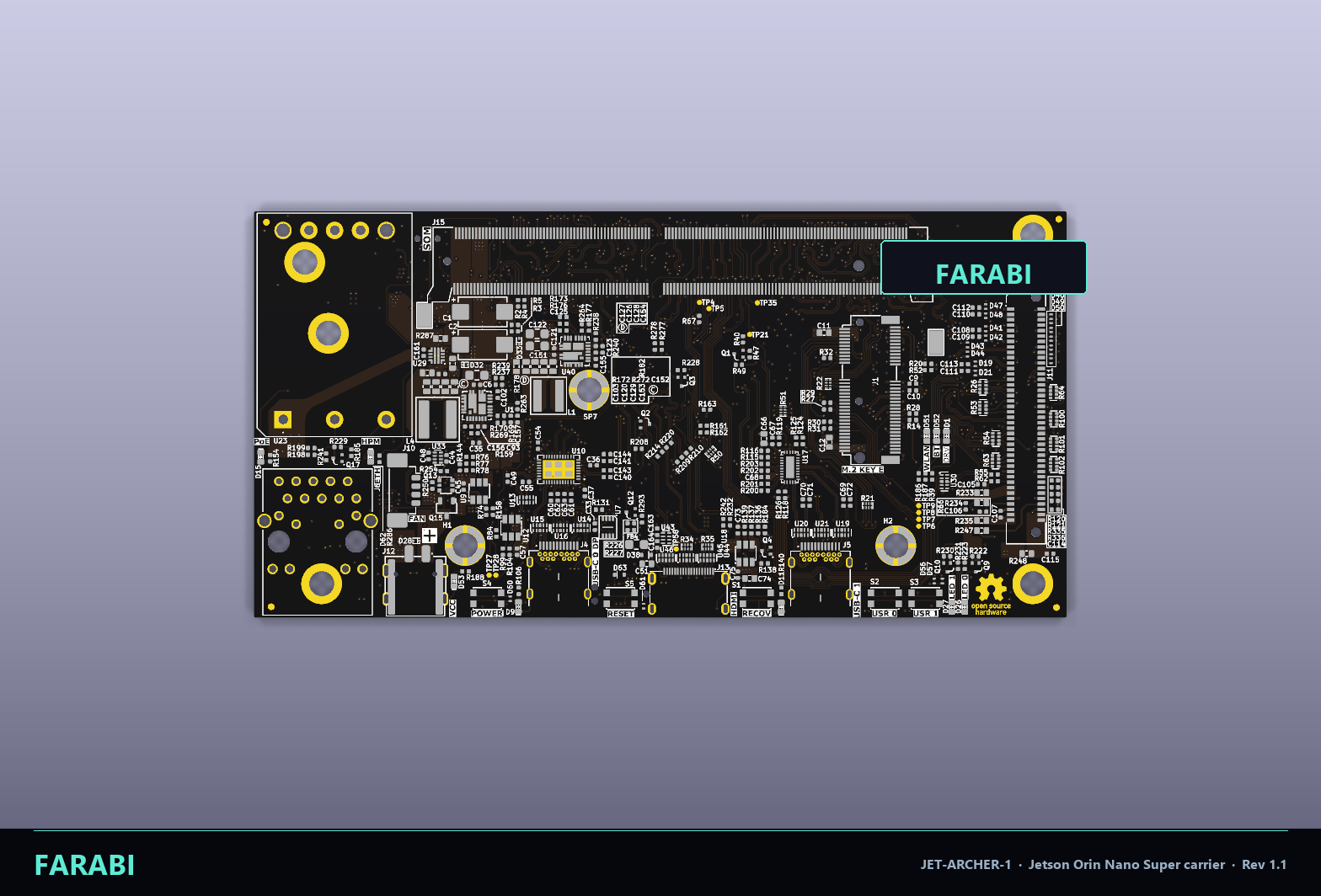
The carrier hosts the SOM, exposes only the I/O we fly, and integrates the 22 V → 5 V power tree. 4-layer FR-4, ENIG, 1.6 mm. Mounts as a secondary deck above the existing FC — Jetson failure degrades gracefully to manual FPV, never grounds the drone.
Parallel, not replacement
The Jetson is a secondary autonomy deck above the FC. Single UART link carries MAVLink intent. Jetson failure → manual FPV continues. Never grounds the drone.
Field-serviceable
SOM swaps via SO-DIMM in <60 s. No soldering. Same airframe survives compute upgrades — Jetson Orin Nano today, Orin NX tomorrow, no PCB respin.
NDAA all the way down
NVIDIA SOM (US-designed), TI eFuse/buck, JAE socket, Hirose FFC, Murata caps. No DJI, Autel, SkyDio components. Blue UAS sourceable down to passives.
03 · Mechanical fit
~40 mm of stack above the FC. Cooled by prop wash.
Vibration-isolated on TPU 30-A grommets. Mounted to the airframe's upper carbon plate on M2.5 aluminum standoffs. Copper heat block (45×50×8 mm, ~25 g) drops sink-to-ambient resistance enough that in-flight Tj stays at 93 °C even at 15 W.
5" race quads can't host it. 8" Archer-class fits cleanly. 10" has headroom for secondary payloads (IR camera, laser rangefinder).
04 · Competitive landscape
Smaller, lighter, cheaper than anything fielded.
No production 5–8" race-class drone today carries an Orin Nano. The closest fielded references are 2× the size and built for a different mission.
| Platform | Compute | TOPS | Size | Mass | $ at 100 |
|---|---|---|---|---|---|
| JET-ARCHER-1 ours | Orin Nano Super 8GB | 67 | 74 × 46 mm | ~120 g | $180 |
| ModalAI VOXL2 | Qualcomm QRB5165 | 15 | 42 × 36 mm | ~16 g (SoM only) | $1,499 dev |
| ARK Jetson Carrier | Orin NX 16GB | 100 | 75 × 50 mm | ~140 g | $399 carrier + $599 SOM |
| Auterion Skynode S | i.MX 8 + STM32 FMU | ~2.3 | 95 × 49 mm | ~250 g | $2,500+ |
| NVIDIA dev kit | Orin Nano Super 8GB | 67 | 100 × 79 mm | ~185 g | $249 (dev kit) |
| Neros Archer (baseline) | custom FC · undisclosed | — | — | — | ~$2,000 unit |
05 · Timeline
Eight weeks. Layout → first untethered autonomy flight.
06 · Why now
Three trends converging in the next six months.
Replicator scales
DoD Replicator 2.0 expanding the Blue UAS list. Neros at 2,000/day output. USMC ordered 8,000 Archers ($17M). The volume is there — the AI uplift isn't yet.
Orin Nano Super
NVIDIA's Dec 2024 release unlocked the 25 W mode and 67 INT8 TOPS at the $249 price point. First time the 5–8" airframe + on-board AI math actually pencils.
AIGP physical qualifier
September 2026 in California. Our race autonomy stack (YOLO + PnP + PID) ports from VQ1 sim to physical airframe with no compute redesign. AIGP is our forcing function.
07 · PCBWay submission package
Ready to upload. Gerbers, BOM, CPL, spec sheet.
The complete submission set — generated locally via KiCad 10 from the open-source Antmicro Jetson Orin Baseboard reference. The Antmicro design is 120 × 60 mm with a feature superset; the JET-ARCHER strip-down to 74 × 46 mm is the layout iteration. Fab the reference today, get working boards in ~10 days, iterate to the compact form factor in parallel.
Step-by-step PCBWay flow
10-step ingestion: upload Gerbers, set impedance control, paste spec notes, upload BOM, upload CPL, mark SOM as consigned, get DFM report in 24 hours.
Two weeks of EE time. $2,800 of parts.
The schematic forks from open-source KiCad. The SOM is in stock at Mouser. The carrier costs $80 per board in 5-up at Sierra Circuits. Eight weeks from green-light to a 67-TOPS Archer-class drone flying autonomy.